How Multi-Unit Franchisees Keep Their Books Comparable Across Every Location
Ask a franchisee with one location how yesterday went and you'll get a number. Ask one with twelve and you'll get a question back: compared to what? A multi-unit portfolio is only as readable as its least consistent store, and consistency is exactly what erodes as the portfolio grows. It breaks fastest when you buy stores from another franchisee and inherit their bookkeeper's coding along with the keys. Whether the units are quick-service restaurants, hotels, or retail stores, the pattern is the same — and so is the fix, which starts with how each day's sales reach the books.
When accurate books still can't be compared
Four Jack's Bagels stores each sold food and beverage yesterday, with beverage running a little under 30% of the day at every one. Here's where their books put it:
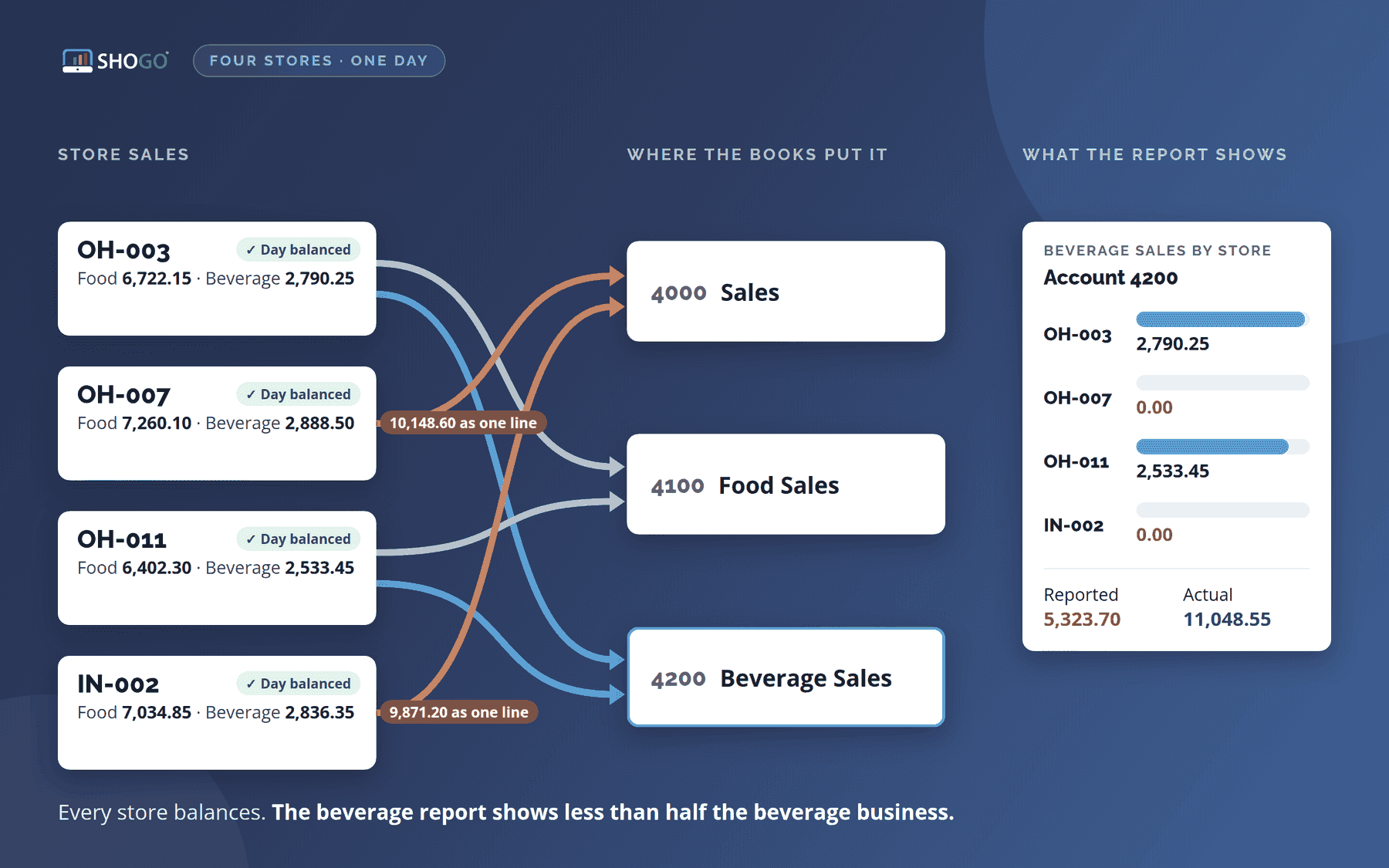
Every one of those books is accurate: each dollar is recorded, and each day balances. But two of the stores post the day as one total, so a report on the beverage sales account shows $5,323.70 of beverage across the four stores instead of $11,048.55, and those two appear to sell no beverage at all. Anyone comparing the stores, or judging how beverage is doing, is reading the wrong numbers. Across a dozen locations, each coded a little differently, no portfolio report can be trusted until someone checks how every store books its sales.
What does "comparable" mean across franchise locations?
Two locations are comparable when the same kind of sale lands in the same account, split the same way, for the same business day. Each part of that sentence does work.
Same account means beverage is beverage at every store — not its own line at one store and buried in total sales at the next. Split the same way means that if one store's sales are broken out by category or channel, every store's are, so the report has the same rows for everyone. (Splitting the day this way is what turns a sales posting into an operating report.) Same business day means Tuesday is Tuesday at every store, posted on the same schedule, so the portfolio view isn't quietly mixing three stores' Tuesday with one store's Monday.
If the accounts, the splits, or the business day differ from one store to the next, the report still lines the stores up side by side, but the numbers are no longer measuring the same thing.
How does Shogo keep franchise locations comparable?
Shogo posts sales for thousands of franchisee locations every morning. Each store's prior business day goes into its entity's general ledger, from one Shogo account, so every location's day arrives the same way at the same time.
Without automated posting, someone enters or imports each store's day into its entity's books, every morning. Twelve stores means twelve postings and twelve chances to post a store's day as one total instead of food and beverage, and both grow with every location you open. With Shogo, nobody keys a store's sales, and every morning, before anyone opens the ledger, one email shows how every store did against last year and, if you've set them, your goals. Whatever the entity structure, each entity's sales land in that entity's own books, tagged with the store's location as a segment, so any report can still be cut store by store.
Set the mapping once. Behind every posting is a mapping — Shogo's word for the rules that decide which account each part of the day lands in. When your stores live in one consolidated ledger — Oracle NetSuite or Sage Intacct with a subsidiary or entity for each LLC — or in one QuickBooks or Xero company because they belong to the same entity, the mapping is set once, and every store follows it. That's what fixes the four stores at the top of this post: every store's food and beverage sales land in the same accounts, and so will the next store you open or buy, from its first day on Shogo. Where a store genuinely differs, its exception is set on that store, without breaking the pattern for the others. Shared mapping applies when Shogo posts each day as a journal entry, which all four general ledgers support; if your stores post another way, each store keeps its own mapping.
A new category, mapped once. When the menu adds something new — merchandise, say — every store starts selling it, and every store needs somewhere to post it. Where stores share one mapping, that new category is mapped once, and every location picks it up at the same time instead of being fixed store by store.
The whole portfolio in one view. Shogo's Sales Overview ranks every store by the prior day's sales, with the portfolio total, month to date, and year to date alongside, each compared with the same period last year and, if you've set them, with your goals. A calendar shows how each day compared with last year, and a weekly chart shows each week against last year and your goals.
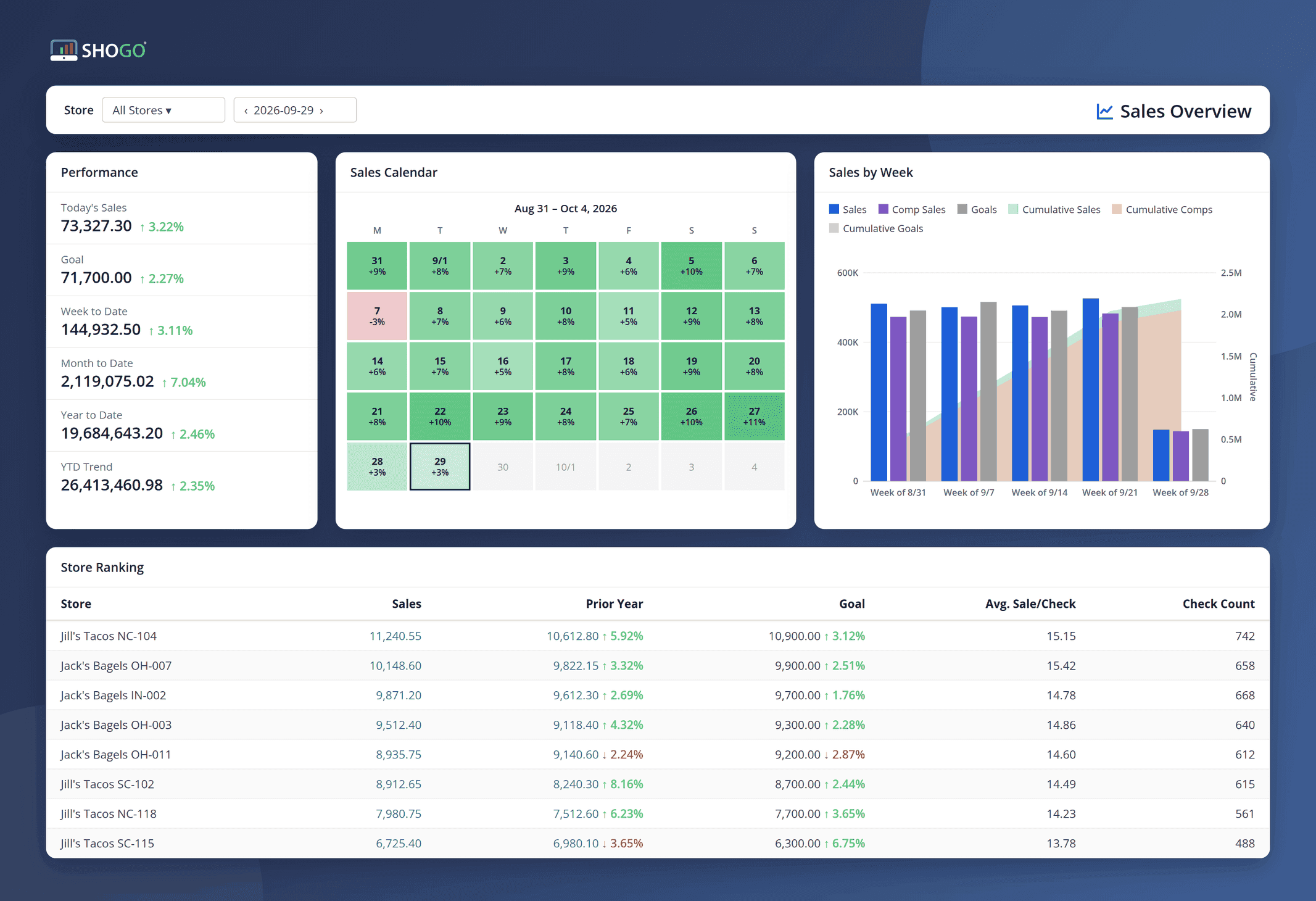
A sample Sales Overview across two concepts, with invented stores and figures. The four Jack's Bagels stores are the ones from the top of this post.
Standalone companies, one Shogo account. When each entity is its own standalone company in the general ledger rather than part of one consolidated ledger, Shogo still posts every one of them from the same Shogo account, on the same morning schedule. The Sales Overview and the daily email still show every store side by side. What changes is setup: each company is mapped on its own, so keeping their charts of accounts alike is what keeps food in food and beverage in beverage across the portfolio.
One Shogo account for the whole portfolio. Every store, every entity, and every concept runs from the same Shogo account, whether the portfolio is a few locations or hundreds. A second concept, even one on a different point-of-sale system, posts on the same morning schedule as the first.
Nobody keys a store's sales. Every location posts automatically each morning, and where stores share one mapping, every store follows it.
Why does the sales line matter for franchise royalties?
Royalties and advertising fund contributions are usually calculated as a percentage of sales, and the franchise agreement defines which sales. Agreements differ on what's in and what's out — sales tax, discounts, gift card sales — and the definition often doesn't match any single number a point-of-sale system reports.
That's one reason Shogo's recommended approach posts gross sales, with discounts on their own line. Starting from gross, with each adjustment visible, you can build the base the agreement specifies and show the franchisor how you got there. Starting from one net figure, you're working backward to find out what's already been taken out.
It's also where inconsistency gets expensive. If two stores define the sales line differently, they report their royalty base differently, and that's the kind of difference a franchisor's audit is designed to find.
How do multi-unit franchisees consolidate across entities?
Consolidation is the general ledger's job, and how it happens follows the entity structure. Oracle NetSuite and Sage Intacct, set up with a subsidiary or entity for each LLC, roll them up within the ledger itself. Separate QuickBooks or Xero companies are combined in a consolidation step outside the individual companies.
Either way, a consolidation is only as good as what goes into it. A roll-up of twelve entities coded twelve ways is a sum, not a report. The daily posting underneath is the same on all four ledgers — automatic, balanced, and in place each morning — and that consistency is what makes the roll-up worth reading.
Frequently asked questions
What is multi-unit franchise accounting?
Multi-unit franchise accounting is keeping the books for a franchisee that operates several locations, often across more than one legal entity, so that every location is accurate on its own and comparable to the others. That means the same kind of sale lands in the same account, split the same way, for the same business day, at every store.
What does Shogo do for multi-unit franchisees?
Shogo posts each store's sales into its entity's general ledger every morning for the prior business day, from one Shogo account across every entity and concept. Where stores live in one consolidated ledger, or in one QuickBooks or Xero company for a single entity, and each day posts as a journal entry, one mapping covers every store, with exceptions set per store.
How do you keep franchise locations comparable in the books?
Keep the same accounts, the same splits, and the same posting schedule at every location. When stores live in one consolidated ledger, or in one QuickBooks or Xero company for a single entity, one mapping can apply across all of them. When each entity is its own standalone company in the general ledger, those companies should share a chart of accounts.
Can one Shogo account post sales for locations in standalone companies?
Yes. One Shogo account can post each store's sales into its own entity's standalone company in the general ledger, every morning for the prior business day. Each company is set up on its own, so keeping them on a shared chart of accounts is what keeps the stores comparable.
How do multi-unit franchisees consolidate financials across entities?
Consolidation follows the entity structure. Oracle NetSuite and Sage Intacct, set up with a subsidiary or entity for each LLC, roll them up within the ledger, while separate QuickBooks or Xero companies are combined in a consolidation step outside the individual companies. In every case, the roll-up is only as useful as the consistency of the daily postings underneath it.